
The Holy Face or the Machine Interface
Past the pancakes, Shrove Tuesday is dedicated to a critical devotion for the third millennium.

The Feast of the Holy Face - A Remarkable Prophetic Devotion and Reflection
If you think it is all too complex, life is confusing but want to do the right thing, to counter dehumanisation and evil becoming more manifest in the mundane - contemplate the Holy Face of Jesus. In this experience there is the possibility to understand in a profound way what and who we are. You will know adversaries to our welfare by those who blaspheme Christ, renounce his legitimate image, mock, deface or scatter from the name. Others reduce representation to commerce, idolatry and blasphemy. That is where the Holy Face comes in. The Little Flower or St. Thérèse of Lisieux embraced the tradition of devotion. The Holy Face is particularly associated with Carmelites in its most seriously developed mystical manifestation but is of general import. That makes sense as they are a ventricle in the heart of the mystic body, enclosed and focused on the interior castle. That is their mission that tends to us by tending to encounter with God. Though Elijah listened to God like a whistling whisper on the wind and is remembered for Mount Carmel, the trajectory of revelation continued to and through the Incarnation. When Baal is back in town, Carmel re-asserts itself and the Holy Face as well.
You know powerful pictures can paint a thousand words. The idea of the Holy Face was anticipated before Christ and realised in the Passion and thereafter. The remarkable respectful representation of the Face of Jesus is an astonishing, authorised and persistent chain of revelation that claims direct linkage to the Passion. The revelation was asked for in the Old Testament. It operates before the written word as part of active events. Incarnation introduced icons or acheiropoieta. Then we have human attempts to acknowledge, record and remember in a process of humble engagement. Idea or identity of the image preceded the Gospels and is echoed since in billions of mental images and representations, notable actual apparitions of private revelation. It is also a weapon in spiritual warfare. The genius of a single image in a number of legitimate forms and interpretations anticipated processes of erasure of human personality and gave the simplest suggestion about how to respond. Reflect on the Face of Jesus. That simple start opens the way to specific devotions that amplify and reconnect to a wider spiral of comprehension by compassion in reparative contemplation. The face depicted focuses on the painful Passion but penumbra extends to the full panorama of pictures. The devotion in the most refined aspects, especially associated with the Carmelites, emphasises the sorrowful, suffering aspect of Christ.
Proper devotion usually gives rise to unexpected fruits which prove reality of the relation. Suggested devotion to the Holy Face is a remarkable endeavour that like all good devotion gives more than it gets from you. Though there are particular prayers and approaches, process of contemplation at the core is an astonishing revelation from a deceptively simple means. Distinctiveness of Christianity manifests in its utter and unique focus on reality of Incarnation and iconic instantiation of a warning against defacing the divine in ourselves - by non-divine interfacing. There is a general recurrence of focus on the Holy Face with a more specific devotional tradition that seems to have arisen as a supernatural response to atheistic materialism. So we can see the general one also in the Shroud of Turin and Veil of Manoppello. The Veil of Veronica in the Vatican has been seen as the true icon ‘vera icona’. Continuity of representing the face of Jesus encompasses a general and very specific tradition supplemented by practices and visions of saints and nuns in particular.
Shrove Tuesday, or what was known popularly as Pancake Tuesday for hundreds of years or Mardi Gras, overshadows the more historically recent Feast of the Holy Face. It became a feast day in 1958. 1884 however is the high point of mentions according to Google Ngram, when a confraternity was approved. Its presence at the start of Lent creates symmetry of meditation that prepares for Easter and is symbolised by display of Veronica’s Veil in Rome on the Fifth Sunday on the way to the Resurrected Face. Showing of the veil corresponded with the veiling of other images in Passiontide. The Holy Face devotion is one of the most remarkable. Although it links back to the Veil of Veronica and Shroud of Turin, it was later emphasised in a series of visions in parallel opposition to the rise of atheistic materialism. The object of devotion is reparation for injuries suffered by Jesus. Today that is a continuing one and continuing abuse. In particular, disrespect of Jesus leads to a need to repair or perhaps acknowledge, recognise and reflect on the dark potency of that harm. Along with the Rosary, Sacred Heart and Arma Christi - the Holy Face is focused on our times.
In many devotions we are first invited to focus on Christ. I suspect some may not see the gifts hidden in the request. The gesture of Veronica was both an act of compassion and a recording or image creation. The tradition of Western art draws heavily on the reality of Incarnation. Yet this is not solely about Jesus but a lesson for us. The face is critical in human interaction. It is crucial in relation to God. We face God in doubt and darkness or turn away into deepening obscurity. With our faces we expose some of ourselves and what is happening inside. In contrast, AI-Posthumanism presents a surveillance society of face-recognition pending reduction of our human identity into ciphers.
As a painter, I studied the figure in painting, exploring the reason for reduction in modern art such that it becomes abstraction, where the human is taken out. Re-presentation of the Holy Face was a reminder of Incarnation and humanness. Geoffrey Hinton and AI leaders tell us the human is not special. Christ re-asserts the human but challenges us to recognise our own humanity by acknowledging divine origin in vindication of embodiment. Great theorists of technology, like Jacques Ellul, emphasise Incarnation as antidote. Christ insists we are not reduced to data-points.
Veronica and significance of the face was a continuation from the life of Jesus from cradle to grave or cave and resurrection. The face is point of encounter for Simeon and Anna in the Temple, the learned teachers there later and that Judas would kiss in betrayal. In the Old Testament holy people asked to see the face of God. But if we get it, it’s still not enough for many. A year after the Little Flower died, the hidden majesty of the Turin Shroud was revealed. Various saints from Cyril to Gertrude to Mechtilde and Edmund had particular regard for the Holy Face. Sister Marie of St. Peter and St. Thérèse of the Child Jesus and of the Holy Face (Little Flower) and Blessed Maria Pierina de Micheli led the way in more recent history as did the Leo Dupont. But where?
In the journey of the face, we must come face to face with Christ so that we can see Christ in others as we were informed. This spiritual insight is reflected in ideas of interpersonal therapy advocated in the last century. They corroborate the inherent value of this face-to-face idea. But in the Catholic tradition engagement is a supernatural spiritual suggestion which invites us through a process of representation to explore and consider the relationship behind the image. It is not about icons or painterly reflection but a process of pointing to a sacred and sacramental path to the vertical and veridical. Once we begin to really recognise reality of the subject in relationship we are forced to align our attention. It is not about worshipping images and never was. The Second Council of Nicaea in 787 emphasised the role of representation as corroboration of the Word made flesh. Catholicism and Orthodoxy are distinguishable from Protestantism, Islam and Judaism in their encouragement of a process of addressing or venerating images as a means of encounter through it. That apostolic Christianity is uniquely in favour of images of Christ and the Virgin Mary was a critical aspect of Western culture before the modern and postmodern phase.
The Feast of the Holy Face and devotion in general is a critical aspect in restoration and protection of the human species in the face of AI-posthumanism. The Holy Face is antidote to the mask and computer interface. We interface with networks. That is precarious but not totally determinative… yet. The Trinity shows how relationship is structured by separate persons in relation. Sister Elizabeth of the Trinity also refers to the face of God. The Holy Face indicates connection with Christ and thus the Trinity through human reflection in a transcendent relation. This suggests the nexus of human face-to-face. That requires a face to be able to interact with another. We need a separate personality with boundaries as a coherent form. Once autonomy or in-betweeness is ignored, autonomy collapses. If we receive an implant, we progress from assisted to controlled cognition. We are no longer interfacing but integrating. The globalist imperative applies also from erasure of boundaries into our own global consciousness by the theatrical globe of technology. We dispose of our divine nature to something else, some other entity. Contemplation of the Holy Face was a gift against our own demise. It is a picture of invitation into relational being. Perichoresis is process of creating space of potential for genesis not an invitation to standardisation. As psychologists like Levinas emphasise, the face commands. The Holy Face commands us to recognise and restore respect for Christ as condition for our own life and civilisation.
God gave us personal identity or what I might call amness, so we could freely enter into a purified, healed, and exalted participation in His life or theosis in full realisation of human potential within the bounds of the nature of our being. Amness requires some sort of anamnesis or remembering God. The Holy Face imprints the central feature of human appearance as expression of the Christ that pre-existed and transcends death and which invites us to direct our potential by its animation. The Holy Face devotion is not merely of the nature of a duty but a practice that operates on a level deeper than any psychology can. We hold what we behold before and after we are told. It is an endeavour and enterprise of encounter and exploration in constant evolution. This is the epektasis of St. Gregory of Nyssa. Or we can choose external permanent revolution that will end interior potential.
One of the specific prayers refers to the recurrent formula of a type of anti-Trinity of - the world the flesh and the devil. This was also the title of a book by J.D. Bernal, the father of the science of science and renowned crystallographer, written nearly a century ago. His book explained how scientific corporations would take over the world, we would be transformed into silicon over time to be immortal, the elite would engage in space exploration to escape the human zoo they create where scientists would experiment on humans. The world of technocratic control seeks to replace the human with engineered form thus losing moral restraint and heading away from God. Most recent popes have addressed the Holy Face and St. John Paul II suggests it will be central for a millennium. Over 800 years ago Pope Innocent III asked us to contemplate the very mystery of the likeness and it has inspired many from Giotto and Dante to Julian of Norwich right back through the role of various Pope Clements to the very first one. This contemplation leads into interesting examinations of inscape and instress in thisness in us and all creatures and nature in the work of Gerard Manley Hopkins. But potential mirror of the face of Christ is accessible portal to the narrow path that leads to God whose full self, unemptied into humanity, is too overwhelming to directly encounter. The face then is linked to appearance of the Eucharist.
The face on the veil is itself the mirror veil that replaced the rent veil on the Holy of Holies and opens up the divine prospect in a reflexive reflection with the creature created. The actual or attempted likeness is still only a reflection barely recorded whose symbolic power condenses theology and history in a primarily non-verbal way. This opens the secondary way of language. But attention comes first, opening a channel to the heart and mind and other person. We might believe we work back from deep philosophy as Edith Stein did, but many Carmelites in particular experienced the Holy Face in image or apparition before its meaning unfolded. Other great mysteries emerged around the Mandylion of Edessa, the Holy Face of Genoa and also of San Silvestro. This face is not the mask and neither is it made up as human faces increasingly are as they need to be hidden even from themselves. Today think of the Holy Face after your pancake.
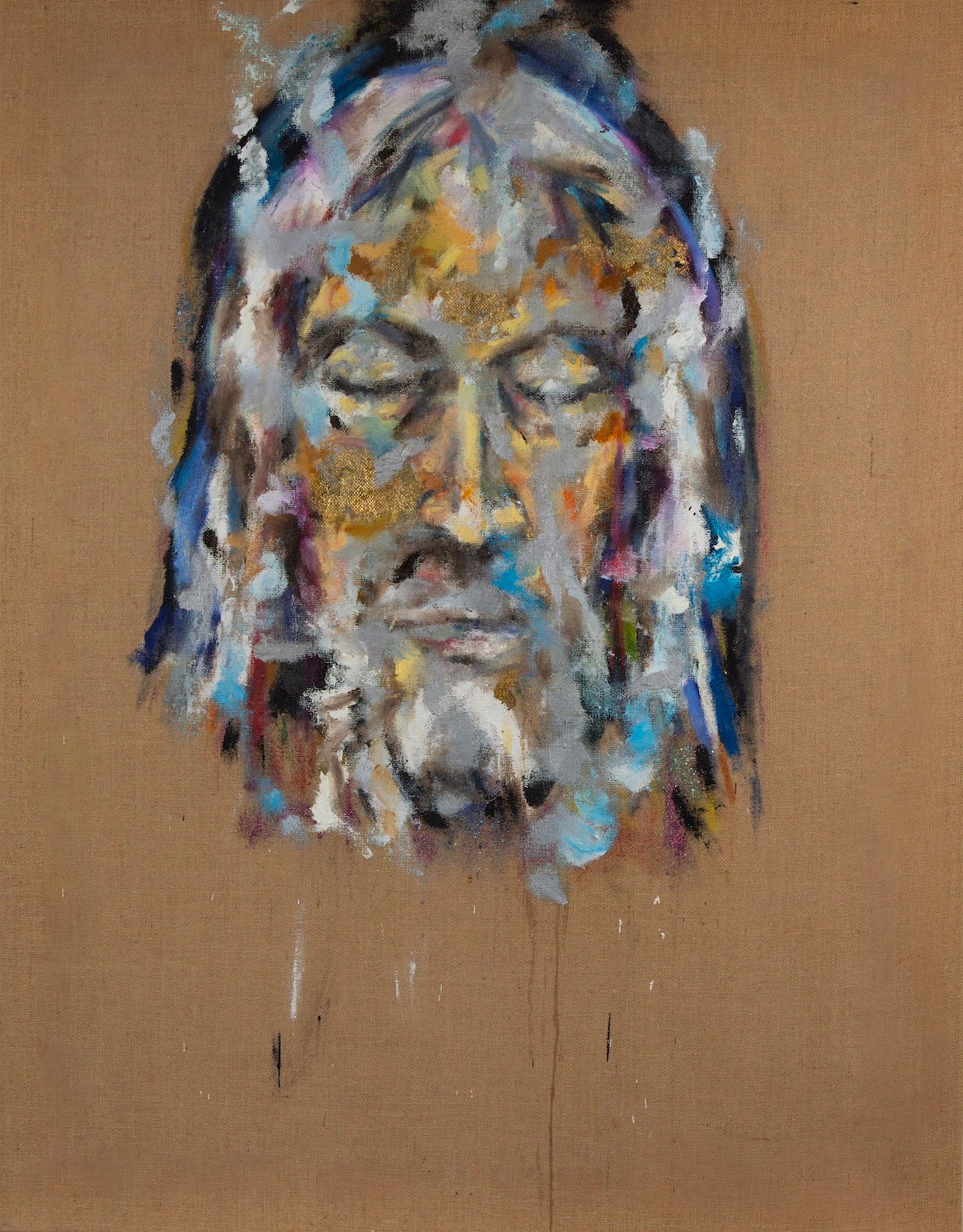
This post contains marketing as images or links to my art or books could be classified as ads under EU law, even when included for reference and illustration.
Thank you for this. Love the last line, and the painting.
This is a wonderful painting. I can feel its energy.